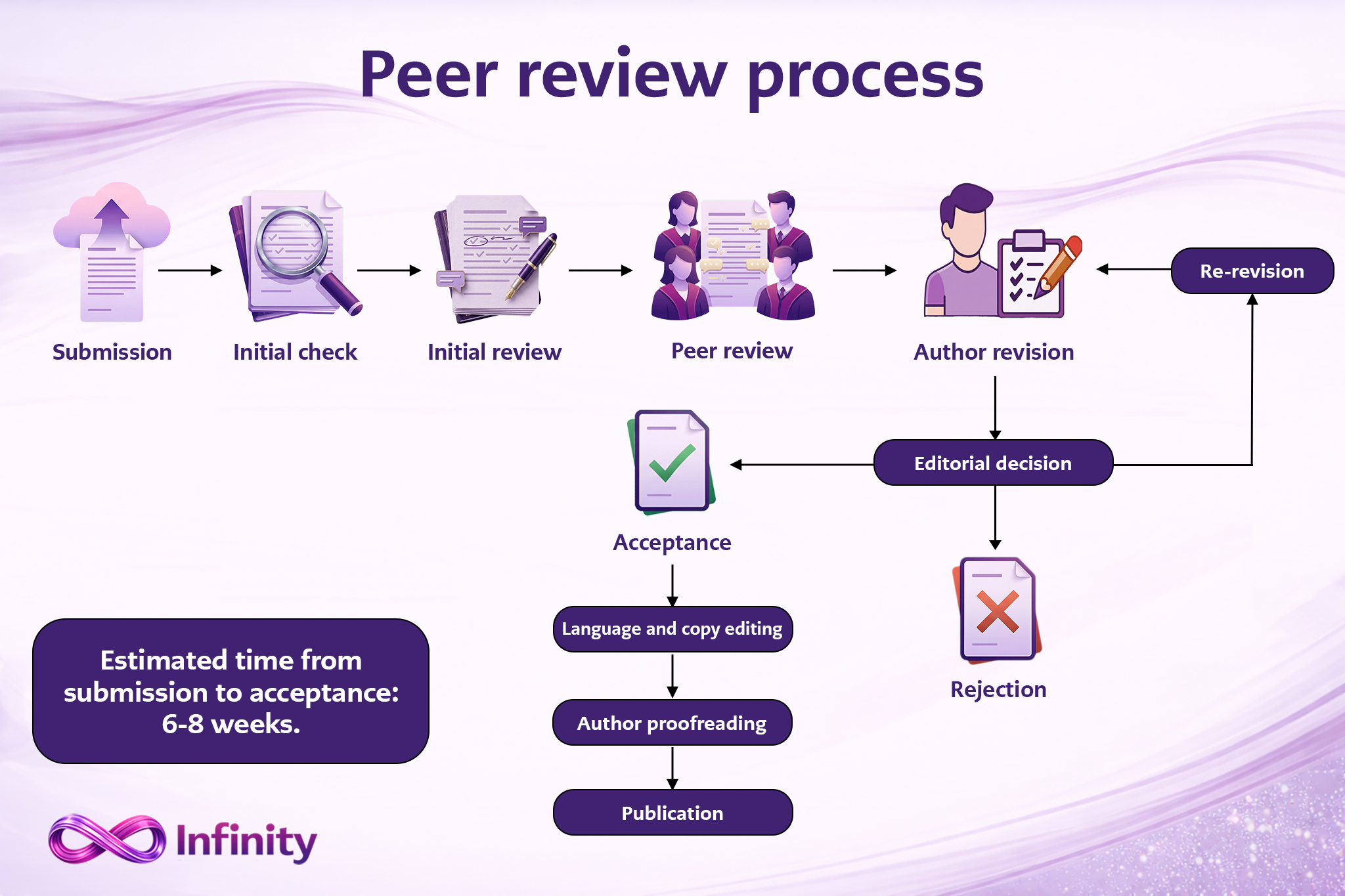
The peer-review and editorial processes are essential to producing high-quality scientific research. Infinity Journals uses a single-blind review system. All suitable manuscripts are evaluated by at least two expert reviewers selected by an editor or the Editor-in-Chief (EIC). Each manuscript undergoes peer review, and authors receive the first decision within three to five weeks of submission. We review all submitted manuscripts without selection bias, ensuring fairness, efficiency, and timely publication. The editorial board and reviewers are selected from among the top researchers in their respective fields.
The peer review and editorial process includes the following steps:
Submission: Infinity journals provide an easy submission system (OJS/PKP) that simplifies the manuscript submission process. Authors can suggest potential reviewers and exclude those with conflicts of interest, ensuring a fair peer-review process. The journals also promote article submissions via email alerts and encourage authors to use the available author guidelines to prepare their manuscripts properly.
Initial check: After submission, all manuscripts undergo a pre-check to ensure they meet the journal's standards, including checks for originality, structure, relevance, references, and required declarations. Manuscripts that are poorly prepared may be rejected at this stage. The editorial office then conducts a technical review to confirm compliance with Infinity guidelines and policies. Next, the Editor-in-Chief assigns the manuscript to an Associate Editor (or Editor), taking any conflicts of interest into account.
Initial review: After the EIC’s initial check, the assigned associate editor, guest editor, or editor assesses the manuscript’s quality, novelty, and relevance to the journal before peer review. Editors are not permitted to access or make decisions about their own manuscripts. Work that is non-original, low-quality, plagiarized, or duplicated is rejected; manuscripts requiring minor revisions or missing basic sections are returned to authors; high-quality manuscripts with valid research questions proceed to peer review. Editors can track manuscript status and reviewer identities at any time, and reviewers and editors can communicate with the editorial office during the review process.
Peer review: Authors may suggest potential reviewers, but the editor may select other qualified experts. The editorial team ensures that reviewers have no conflicts of interest, hold at least a Ph.D., and have recent publications in the manuscript’s research area. Authors may also request that certain reviewers be excluded. Each manuscript is evaluated by at least two independent reviewers in a single-blind peer-review process, with typically no more than two rounds of major revisions. Editors consider reviewer recommendations, and authors must respond to all comments for both minor and major revisions. Revised manuscripts may be sent back to reviewers, who can access the latest version through the submission system.
Author revision: Based on reviewers’ comments and the manuscript’s quality, the assigned editor will decide whether to accept, request revisions, resubmit for review, or reject. Authors must submit minor revisions within one week and major revisions within two weeks, along with a point-by-point response to the reviewers’ comments.
Editorial decision: The assigned or guest editor makes the initial decision after confirming that all reviewer comments are addressed and that the manuscript meets publication standards. If revisions are insufficient, a second revision may be required. If the manuscript still does not meet standards after this, it may be rejected. The Editor-in-Chief makes the final decision. Accepted manuscripts proceed to production and publication.
Acceptance: After the manuscript is accepted, the editorial office will issue an acceptance notification to the authors.
Production: All accepted manuscripts undergo language and copy editing, including formatting to the journal style and XML conversion. A PDF proof is sent to authors for final review and proofreading before publication. The quality of figures, tables, and images is checked and, if necessary, improved. Professional English editing is provided. Comprehensive editing is available for an additional fee with author approval, though authors may also use other editing services.
Post-Publication Services: After production, all accepted articles are published electronically as PDFs and made available online. Published papers are tracked for total views, downloads, and citations to assess impact. Readers are encouraged to submit commentary, corrections, or corrigenda, which will be reviewed and linked to the original article. Authors may also share supplementary materials or updates after publication. For inquiries or correction submissions, contact the editorial office directly.
Figure showing the Peer Review Process at the Infinity Publisher